The truck left on a fake order: how hackers steal cargo without going near the warehouse
The FBI warns that criminals increasingly steal cargo not on the road but through email and load boards. Losses in the US and Canada in 2025 reached nearly $725 million, 60% more than a year earlier. We break down the scheme and share a checklist for logistics companies.
---
## What it looks like from the outside
A carrier's dispatcher receives an email from a broker the company has worked with for years. A routine request: check the details of a new load via a link. The dispatcher opens the link, nothing unusual happens, and they get back to work.
A week later the shipper calls: where is the cargo? According to the paperwork it was picked up by your company, your driver, on your order. Except you don't recognise the order or the driver.
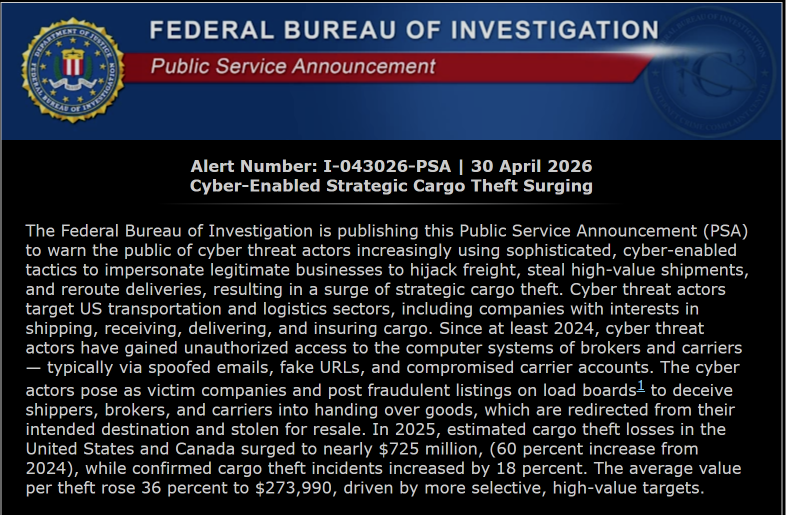
This isn't an invented story — it's the typical scenario the FBI describes in its warning of 30 April 2026. Cargo is stolen not on the highway or from a warehouse, but through email, user accounts and online load boards.
## The numbers
According to the FBI, cargo theft losses in the US and Canada in 2025 reached **nearly $725 million**. That is **60%** more than the year before.
- the number of confirmed thefts grew by **18%**;
- the average value of a single theft grew by **36%** to **$273,990**.
The last figure tells the main story: criminals don't take whatever they can. They pick high-value loads and prepare the theft in advance.
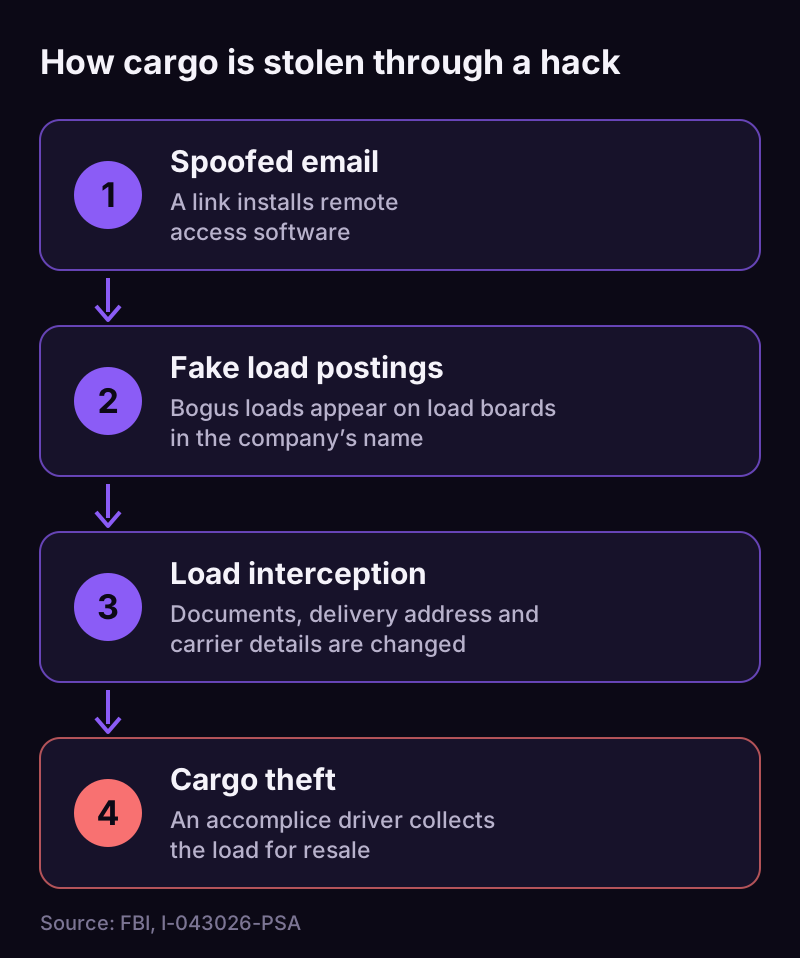
## The attack in four steps
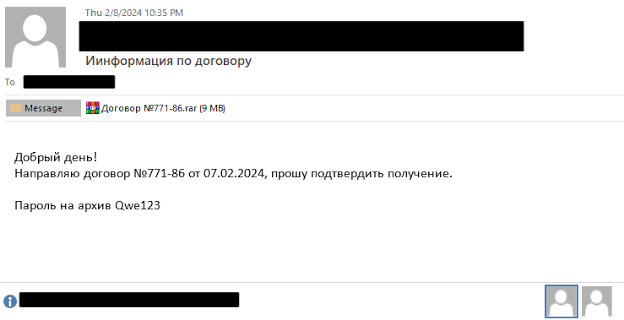
1. **Account compromise.** A broker or carrier receives an email that looks like ordinary business correspondence. The link leads to a fake website, which installs remote access software on the computer. From that moment the criminals can see the company's email, orders and correspondence.
2. **Fake load postings.** Bogus loads appear on load boards in the name of the compromised company. This is how the criminals reach other carriers and widen the circle of victims.
3. **Load interception.** The criminals book real shipments in the name of the compromised company, change the documents and the delivery address, and sometimes even the carrier's registration details.
4. **Cargo theft.** An accomplice driver collects the load and takes it away for resale. Sometimes the company is then also asked to pay a ransom.
The worst part: the legitimate company is often the last to learn about the breach. Usually it happens when a broker starts looking for a missing load booked in its name.
## Why this isn't just an American problem
The FBI warning was written for the US and Canada, but the scheme isn't tied to any country. It works wherever transport orders are accepted by email, through online load boards and messengers, and where confirmation often comes down to "the email came from a familiar address".
Logistics companies in Uzbekistan and neighbouring countries use the same tools. And transit shipments involving several intermediaries from different countries give criminals even more entry points.
## Signs your company is already being used
- brokers or clients ask about loads you never booked;
- load postings you never published appear on a load board in your name;
- your company's contact or payment details have changed on a load board or in registries;
- remote access software nobody installed has appeared on work computers;
- your mailbox has rules forwarding messages to an unknown address;
- clients complain about emails "from you" asking to change payment details or the delivery address.
## Checklist for a logistics company
This list can be printed out and pinned up next to the dispatchers.
1. **Confirm orders by phone.** Confirm any new order, change of delivery address or payment details using a number you already know, not the contacts in the email.
2. **Turn on two-factor authentication** for email, load boards and the transport management system.
3. **Don't install software from links in emails.** Any software is installed only by an IT specialist.
4. **Control remote access.** Approve a list of allowed remote access tools and block everything else.
5. **Check your company profile regularly** on load boards and in registries: contacts, payment details, list of users.
6. **Match the driver and vehicle against the order at pickup.** Record the driver's name, the vehicle number and the driver's documents.
7. **Check your mailbox for forwarding rules.** At least once a month.
8. **Train your staff.** A dispatcher who knows what a fake email looks like is the best protection.
9. **Prepare a response plan.** Who calls whom if a load goes missing or an account is compromised: the client, the broker, the load board, the police.
## The bottom line
Cargo theft through a hack cannot be prevented by warehouse guards or a GPS tracker. It starts with one email and one click, and ends with the load leaving — legally, on paper — for the criminals.
Protection here isn't a single product but a combination of discipline (confirming orders through a second channel) and control over what happens in the dispatchers' email and on their computers.
If you want to know how vulnerable your company is to this scheme, we'll carry out an [information security audit](/services/audit) and show you the weak spots before criminals find them. Or simply [get in touch](/contact).
---
*Based on FBI warning [I-043026-PSA "Cyber-Enabled Strategic Cargo Theft Surging"](https://www.ic3.gov/PSA/2026/PSA260430) of 30.04.2026.*